Questions You’ve Raised
How do you respond if your publisher demands preferential business news treatment for a personal friend or large advertiser?
The circumstances are admittedly challenging. In reality, you may have to accept – grudgingly – that the publisher wins. That said, you need to have the conversation and present the strongest argument that fair and responsible coverage is at the heart of the newspaper’s credibility. That applies to business news as well as to any other coverage area. It may be even more important in business news because of the perception that “dollars speak” and impact news decisions.
Be aware that news travels. This may prompt similar requests. How do you defend saying “yes” to one person and “no” to another? Haphazard policies – double standards – are worse than no policies at all.
Also, be aware of the “what” vs. “whom” when it comes to other news coverage. I’ve seen major advertisers press for something to be kept out of the police log. I’ve seen publishers ask for a story that would not be done under the normal filter of what is news and what isn’t news.
How can nondaily newspapers compete with daily media and their instantaneous online coverage of election campaign issues?
The web provides nondailies the same capability of instantaneous online coverage – and not only during election season. Digital platforms ought to be at the forefront in dissemination of all news. Following that, customize the news to your readers.
Specific to elections, you can tailor your stories to the local issues most important to your readers. Identify these issues at the beginning of election season and use them as a barometer of your coverage. Another opportunity to tailor your coverage – and engage your readers – is to enlist a local panel of citizens at the beginning of the election season. These individuals can offer their perspectives on the candidates and the issues at regular intervals. If candidates have a major press conference that generates widespread attention, the local panelists can post their comments online, thus making your coverage both timely and relevant to your audiences.
We’re trying to get more voices on our editorial page other than the usual letter writers. We also find it challenging to write local editorials. Any suggestions?
Point/counterpoint commentaries are an excellent starting point to address both of your concerns – and to supplement your newsroom resources. Make it a point at staff meetings, or as part of a regular review, to identify key issues being debated in your communities. Such things as school referendums, a controversial commercial development or a contentious feedlot permit are ready-made topics.
In addition, think of the numerous other issues that are commonplace in many communities and ripe for debate – proposals for all-day kindergarten, skateboard parks, teen centers, special taxing districts, business subsidies, land annexations, riverfront developments, highway bypasses. Newsrooms often are pressed to fully report on these issues. So why not regularly solicit pro/con viewpoints. Publish these with the individuals’ mug shots, and use a photo or a graphic to illustrate and enhance the layout. These can take time to put together, so start slowly – maybe once every three months.
These exchanges will likely prompt others to weigh in on the issue and also might prompt the newspaper to take an editorial stance. Above all, you’re using the newspaper to enrich community discussion on important topics.
We received a letter to the editor criticizing the high prices and poor service at a local food chain. The letter urges local action. Would you publish?
It’s a slippery slope to open your letters column to criticism of businesses. A couple of points on enforcing such a policy:
No. 1, the policy is a double-edged sword. If you reject the critical letters, you’ll be hard-pressed to publish the complimentary letters.
No, 2, make the distinction between public and private issues. We had a vigorous debate in our community where a grocery store was expanding and changing its franchise. The expansion included closing a road which provided a shortcut from our downtown to the bridge that crossed the river into another state. The shortcut was routinely used by emergency vehicles. The safety issue was raised at public hearings, and we allowed the debate in the letters column. However, we rejected letters critical of the change in store franchise that meant customers would now have to bag their own groceries.
As with all policies, there are exceptions. A motorist passed through town on a Sunday evening. His car broke down, and most service stations, etc., were closed. He recounted the many good Samaritans – and identified specific businesses – who helped him get on his way that evening. It was truly a “spontaneous” thank-you and was more a commentary on the goodwill of the entire community vs. specific businesses. We published the letter.
Newspapers should regularly address and explain their news operations and policies to readers. Why newspapers accept or reject letters commenting on private businesses is excellent fodder for such a column.
You advocate including someone from the advertising department on a newspaper’s editorial board. How can those individuals be objective? Won’t they simply be looking out for the newspaper’s financial interests – as opposed to the community’s best interests – when framing the newspaper’s editorial positions?
The goal of any editorial board is to seek a broad spectrum of opinions. There is no set formula for editorial board representatives, but the process ideally should solicit opinions from beyond solely the news department. Some newspapers include representatives from the community at-large.
The best editorial boards – if they are to remain dynamic – should include rotating and permanent members. Individuals assigned on a rotating basis might include someone from the newspaper’s production and advertising departments as well as the community members. The editor and publisher fall in the category of permanent members at any newspaper. In that regard, no one is more interested in a newspaper’s financial health – and a community’s well-being – than the publisher.
A bank forecloses on a house, and a court order is issued to evict the family. Police surround a house for nearly two hours waiting for the family to leave their home. All ends peacefully. It is the last of 35 eviction orders served that day. What do you report?
The newspaper has an obligation to report the circumstances of this specific eviction; the standoff is news in the neighborhood. Beyond that, however, is the “second-day story” that newspapers often ignore. This is an example of a sensitive – and important – story that demands follow-up.
The real news is that this was the 35th eviction served in a single day. That fact raises all sorts of questions and potential stories. Among them: Did these evicted families share a common profile? Where did they spend the next night, week, month? Are there community resources to assist them – before they ever reach this point and after their eviction? Coverage of sensitive stories demands attention on two fronts: fair and consistent coverage of the event itself, and examination of follow-up stories that offer greater understanding to the original event.

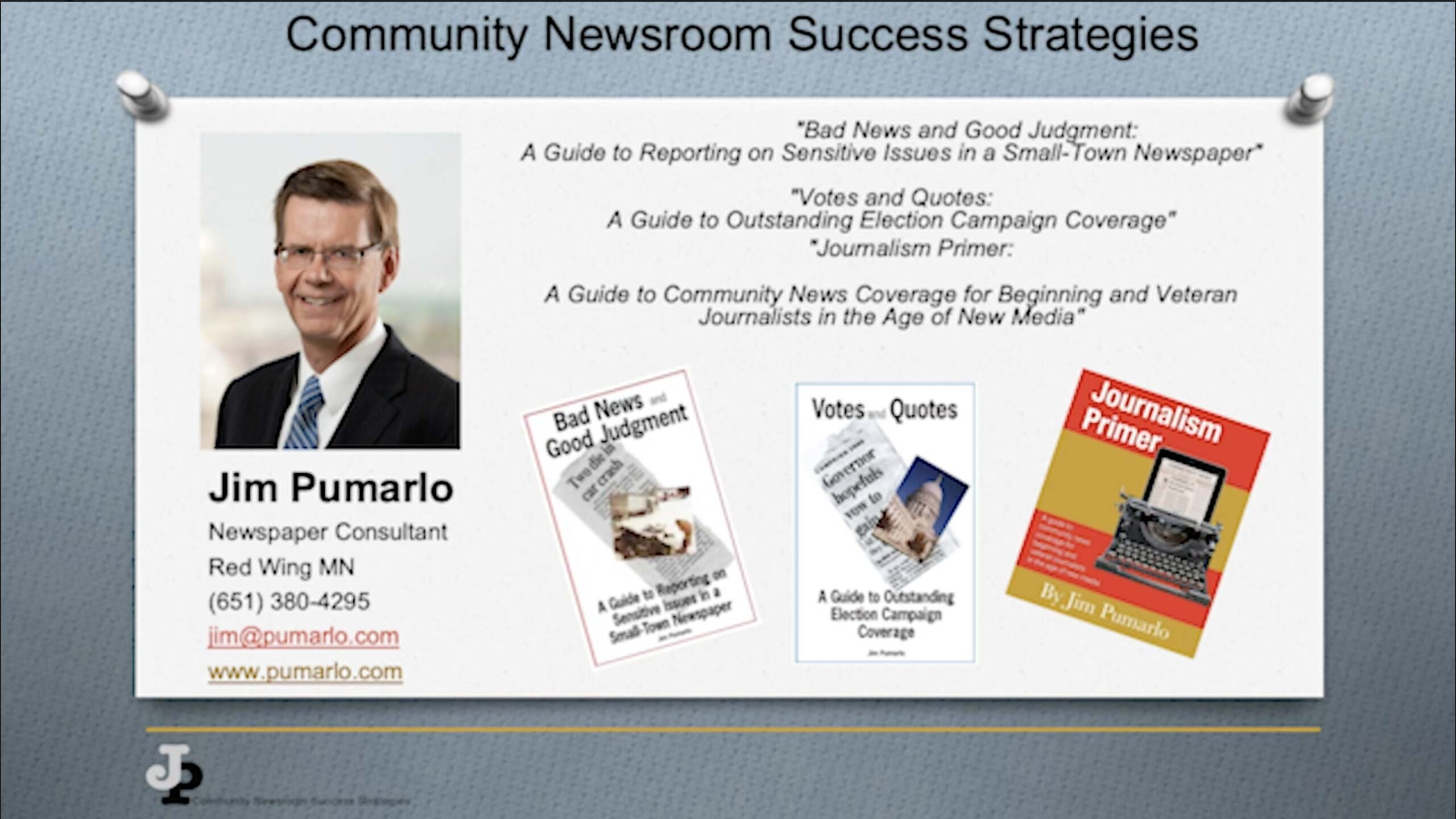
Who is Jim Pumarlo?
Community newspapers, at their best, are stewards of their communities. The news columns are a blend of stories that people like to read and stories they should read. The advertising columns promote and grow local commerce. And the editorial pages are a marketplace of ideas.
Jim Pumarlo understands that energized newspapers are at the foundation of energized communities. His message is straightforward: Community newspapers – whether delivering information in the print or on the Web – must focus on local news if they are to remain relevant to their readers and advertisers.
Current Schedule
2023
March
9 – Online Media Campus
Webinar: “Business News as an Everyday Beat”
2022
September-October
Minnesota Newspaper Institute and Bethel University, St. Paul
Five-part online course to train citizen journalists
Assisted in developing curriculum, and presented session on public affairs coverage and meeting reporting
June
8 – National Newspaper Association Foundation
Webinar: “Interviewing Skills: Techniques and Improving Observation in Volatile Situations”
Co-presenter with Corey Hebner, Michigan State Police community service trooper
2-3 – Texas Center for Community Journalism, Management Boot Camp
Presenter: “Finding Time for Editorial Projects”
Presenter: “Delivering What Your Community Wants: Connecting with Your Readers”
Panel participant: “Leading the Newspaper, Leading in Your Community”
May
5 – National Newspaper Association Foundation
Webinar: “Your Role in Election Coverage: Why You should be on the Front Lines”
Co-presenter with Al Cross, director of Institute for Rural Journalism and Community Issues
19 – National Newspaper Association Foundation
Webinar: “Outstanding Election Coverage: Identifying the Elements”
Co-presenter with Al Cross, director of Institute for Rural Journalism and Community Issues
January
28 – Minnesota Newspaper Association Convention
Panel participant: “Reconnecting with Your Community”
2022
September-October
Minnesota Newspaper Institute and Bethel University, St. Paul
Five-part online course to train citizen journalists
Assisted in developing curriculum, and presented session on public affairs coverage and meeting reporting
June
8 – National Newspaper Association Foundation
Webinar: “Interviewing Skills: Techniques and Improving Observation in Volatile Situations”
Co-presenter with Corey Hebner, Michigan State Police community service trooper
2-3 – Texas Center for Community Journalism, Management Boot Camp
Presenter: “Finding Time for Editorial Projects”
Presenter: “Delivering What Your Community Wants: Connecting with Your Readers”
Panel participant: “Leading the Newspaper, Leading in Your Community”
May
5 – National Newspaper Association Foundation
Webinar: “Your Role in Election Coverage: Why You should be on the Front Lines”
Co-presenter with Al Cross, director of Institute for Rural Journalism and Community Issues
19 – National Newspaper Association Foundation
Webinar: “Outstanding Election Coverage: Identifying the Elements”
Co-presenter with Al Cross, director of Institute for Rural Journalism and Community Issues
January
28 – Minnesota Newspaper Association Convention
Panel participant: “Reconnecting with Your Community”
2021
May
21 – Colorado Press Association/Kansas Press Association Joint Virtual Convention
Webinar: “Bad News and Good Judgment: A Guide to Reporting on Sensitive Issues”
February
11 – Alabama Press Association Media Summit & Winter Meeting
Webinar: “Business – an Everyday Beat”
January
15 – Wyoming Press Association Convention
Webinar: “How to make public affairs coverage relevant and timely”
2020
July
30 – New England Newspaper and Press Association
Webinar: “Covering Business News in Challenging Times”
30 – California News Publishers Association
“Finding Time for Big Editorial Projects”